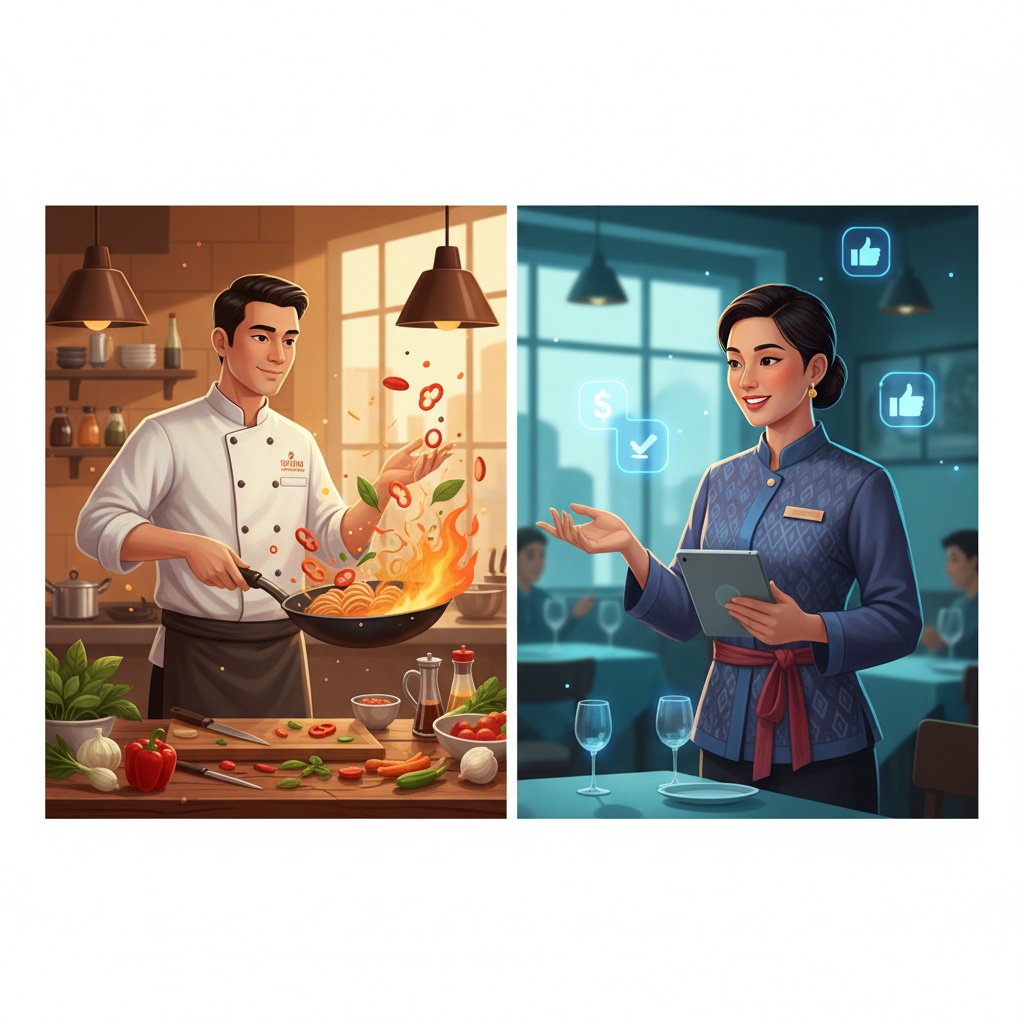
Ever walked into a bustling American Thai kitchen during the Friday night rush? It’s a beautifully orchestrated chaotic dance, a symphony of sizzling woks, sharp steel hitting wooden boards, and ticket machines spitting out orders faster than a printing press. But behind that curtain of vaporized chili oil lies a massive cultural and operational gap that can make or break a restaurant’s bottom line.
I remember talking to an old friend who opened a gorgeous spot in Chicago. He hired a highly skilled chef straight from Chiang Mai. The man was a culinary artist. But on his first busy weekend, the kitchen collapsed into a screaming match. Why? The chef was used to the relaxed, multi-technique, decentralized flow of open-air markets back home, not the hyper-fast, single-owner, standardized line system of a high-volume U.S. kitchen. It was an expensive lesson: culinary talent is only half the battle. To truly thrive, both back-of-house (BOH) and front-of-house (FOH) staff need a specific set of critical competencies tailored for the American market.
Back of House: Technical Mastery and the Need for Speed
In the culinary world, flavor is king, but consistency and speed are the dual thrones it sits upon. For a Thai chef in the U.S., the transition from domestic cooking to commercial operations requires an immediate shift in technical execution. The American kitchen relies on a highly structured, single-owner methodology where every dish must look and taste identical, regardless of who is working the station.
First and foremost is the mastery of cooking techniques adapted for high volumes. Chefs must transition effortlessly between intense heat applications like stir-frying (pad), deep frying (thod), grilling (yang), and preparing delicate cold salads (yam) under intense time pressure. This requires impeccable knife skills. In the U.S., prep work isn’t just about speed; it’s about absolute portion control. Consistent cuts mean even cooking times, which leads directly to predictable food costs.
Furthermore, American food safety and sanitation laws are notoriously strict. A top-tier chef must treat ServSafe standards not as a chore, but as a critical part of their professional identity. Correct food storage, temperature logs, and allergen management are non-negotiable. Finally, time management is the ultimate survival skill. During peak hours, a kitchen worker must be able to prioritize tickets, communicate with other stations, and maintain composure. If a kitchen can’t turn out an appetizer in eight minutes and an entree in twelve, the front of the house suffers, and the business bleeds money.
Front of House: Communication, Cash, and the Art of the Tip
If the kitchen is the motor, the service staff is the steering wheel. In U.S. Thai restaurants, a server isn’t just someone who carries food from point A to point B. They are educators, sales representatives, and primary customer service ambassadors. The entire business model of American dining hinges on customer satisfaction, which directly translates to profitability through repeat business and tipping structures.
This is why strong English communication skills are an absolute necessity for anyone looking to secure a waiter or runner position. Servers must be able to speak clearly and listen actively to write orders accurately. But the real magic happens when they use their language skills to educate. Many American diners are intimidated by unfamiliar ingredients or spice levels. A great server bridges this gap, translating authentic Thai flavors into terms a local diner can appreciate, gently steering them away from “safe” dishes toward high-margin, authentic menu items.
How do they handle the inevitable upset customer with grace? That’s where conflict resolution comes into play. In the U.S., complaints must be handled immediately, openly, and with empathy—attributes that are part of the core “power skills” required in modern hospitality. Additionally, servers must possess the math skills to handle split checks, calculate change, and manage credit card transactions on complex Point of Sale (POS) systems like Micros or Aloha. Understanding that their personal income is tied to customer experience turns the server role into an entrepreneurial venture, driving higher standards of service across the board.
Cultural Integration: Navigating the U.S. Workplace
Perhaps the most challenging obstacle for Thai expats isn’t the physical work, but the invisible cultural landscape. The American professional environment heavily values constructive feedback, proactive communication, and flat hierarchies where employees are encouraged to share their ideas with management.
However, many Thai-owned establishments in the United States operate under traditional, hierarchy-heavy structures. In these settings, challenging a senior manager or offering unsolicited advice can easily be misinterpreted as a lack of respect, leading to friction or even job loss. For an expat worker, the key to success is adaptability and cultural intelligence.
When working for a traditional owner, the smartest initial strategy is to observe, actively listen, and follow the owner’s established methods to the letter. Learn the cultural equivalent of “Yes, Sir/Ma’am” to demonstrate deference early on. Once trust is firmly established and your work ethic is proven, you can gradually introduce new ideas or feedback in private, respectful one-on-one sessions. Balancing the assertive, feedback-driven nature of American business with the respectful harmony of Thai culture creates a highly resilient, invaluable employee who can navigate any kitchen or dining room in the country.
For restaurant owners, hiring for this unique blend of hard technical skills and soft cultural adaptability is the secret to building a stable, profitable business. For workers, developing these skills is the fastest ticket to a lucrative, long-term career in the highly competitive American culinary landscape.
Book a 15 minute discovery call to find out more today at https://digifidelis.com/calendar/

0 Comments